Why we set trusses with a crane
Garages · 5 min read ·
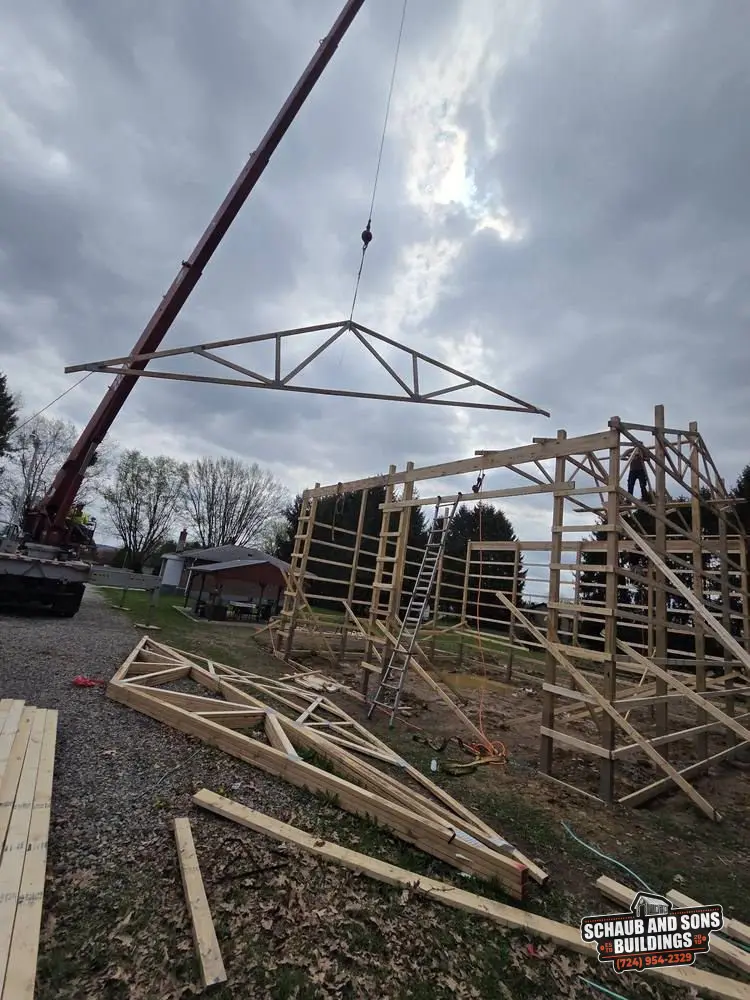
A crane lands each truss where it belongs, keeps the crew off ladders while heavy framing swings overhead, and usually shortens the day. On wider garages and barns it is the safer, straighter way to stand up a roof frame.
What a truss is, and why it is awkward
A truss is a factory-built triangle of lumber that carries the roof from one wall to the other. It is light for its strength, but it is long, floppy until it is braced, and it has to land on top of walls nobody can comfortably stand on.
Raising trusses by hand means pushing them up from below, walking them into position and hoping nothing twists. On a wide building that is slow, and a long truss catching a gust while someone is on a ladder is a moment worth avoiding.
Two jobs, two lifts
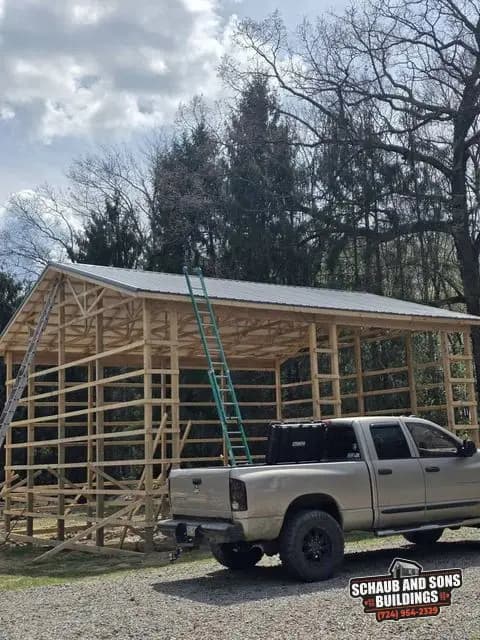
On April 15, 2026 a crane lifted the trusses onto our posts-to-metal-roof barn. The posts and girts were already braced and waiting, so each truss came down onto its posts, got fastened, and the next one followed.
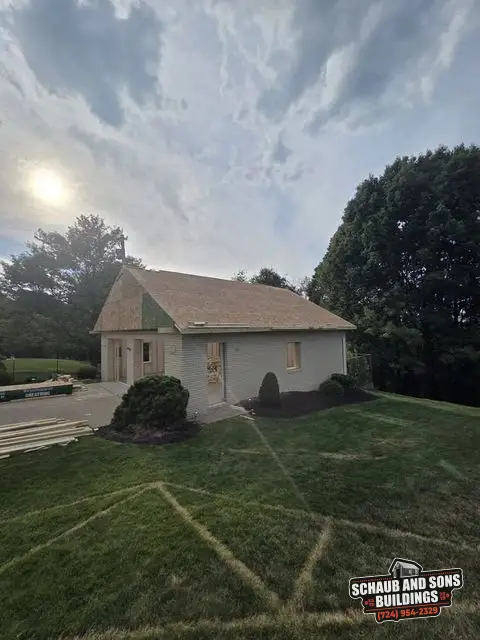
On July 27 the crane was back for the block garage, setting engineered trusses onto block walls. While it worked, a crew member sheathed a gable truss flat on the driveway so that truss could go up already covered.
Build it low, lift it once
That driveway gable is the clearest argument for a crane. Cutting and nailing a sheet at ground level is quick and accurate. Doing the same thing at the peak of a roof, from a ladder, is slower and riskier.
The same thinking applies to bracing and blocking. Anything that can be assembled on the ground and lifted in one piece usually should be.
Straighter rooflines
A crane holds each truss steady while the crew lines it up, so spacing stays even and every truss stands plumb. From inside the April barn you can see the result: a clean grid of trusses and purlins before any metal went on.
Straight framing pays off on top. Metal panels and shingles both show what is underneath, and a truss that leans tends to become a visible wave in the finished roof.
Cranes need room
A crane truck has to reach the building, set up on firm ground and swing clear of wires and trees. When we walk your site, we look at where it will park and how it will get in from the road.
Smaller structures, like a porch cover, use shorter and lighter trusses, and in many cases those go up without a lift. We decide job by job. Our porch cover note covers that kind of build.
What it means for you
For most owners the crane is there for part of a day, and the roof frame is often standing by evening. There is nothing for you to arrange; it is part of how we plan a garage or barn.
To see where truss day falls in the full sequence, read our step-by-step pole barn note.
Questions
Why do builders use a crane to set roof trusses?
Builders use a crane to set roof trusses because the crane holds each long truss steady while the crew fastens it, which is safer than lifting trusses by hand from ladders and keeps the spacing straight. Schaub and Sons crane-set trusses on a pole barn in April 2026 and on a block garage in July 2026.
Does every garage need a crane for the trusses?
Not every garage needs a crane for its trusses. Small structures with short spans, such as many porch covers, use lighter trusses that can often be set without a lift. Wider garages and pole barns usually go faster and straighter with a crane. Schaub and Sons decides whether to bring a crane after seeing the building plan and the site.
What does a crane need to reach my building site?
A crane truck needs a firm place to park near the building, a clear path in from the road, and room to swing trusses without hitting power lines or trees. Soft ground and tight driveways can limit where a crane sets up. Schaub and Sons checks crane access during the site visit for any garage or pole barn.
Can sheathing go on a roof truss before the crane lifts it?
Yes, sheathing can go on a gable truss before the lift. On a Schaub and Sons block garage in July 2026, a crew member sheathed a gable truss flat on the driveway while the crane set other trusses, and the sheathed truss then went up in one piece. Work done on the ground is quicker and more accurate than work at the peak.